Why we avoid sentence strips with gestalt language processors
Jan 28, 2026
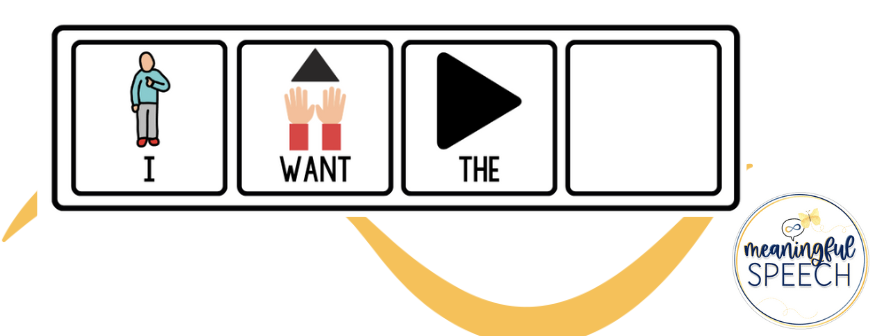
Sentence strips are visuals commonly used in traditional speech therapy to prompt carrier phrases using a cloze procedure or fill-in-the-blank format, such as:
“I want ___”
“I need ___”
“Can I have ___”
When used in language therapy, sentence strips are typically intended to increase a child’s vocabulary, length of utterance, and grammatical skills. They are taught with the expectation that the child will use the language independently. While this approach may be effective for analytic language processors, it is not appropriate for gestalt language processors (GLPs).
Gestalt language processors acquire language differently. Rather than building language word by word, they learn in whole chunks (gestalts) that are meaningful to them. Because of this difference, strategies that rely on teaching and prompting specific sentence structures can interfere with natural language development.
Below is an example of what a sentence strip may look like:
Why Should We Avoid Sentence Strips with Gestalt Language Processors?
1. They promote taught language instead of acquired language. The use of carrier phrases and sentence strips is direct teaching which would result in the utterance made by the child to not be scored in NLA language samples. We only score naturally acquired language when scoring using the Natural Language Acquisition framework. The language acquired through sentence strips is not picked up by the child because it is meaningful to them but rather, the language is taught with the expectation it be used by the child.
2. Most gestalt language processors do not need visuals of carrier phrases to learn language.
Most gestalt language processors typically acquire language simply by hearing it in their environment. They listen, process, and later use the gestalts that are meaningful to them. They do not need visuals of carrier phrases or fill-in-the-blank formats to do this.
(Note: This does not refer to AAC. AAC is a separate topic and can be very supportive when used appropriately.)
An exception may be children who are hyperlexic. If written language models are used, they should be whole-phrase, text-based models (not carrier phrases) and should be modeled without expectation that the child produce them.
3. Carrier phrases are difficult to “unglue.” For many gestalt language processors, carrier phrases take a long time to learn. Once learned, they can become difficult to break apart as the child moves through the stages of language development. These phrases often become overgeneralized and used in a rigid or robotic way.
For example, children with a history of traditional therapy may attach “I want” to many utterances, even when it does not fit the situation. This can interfere with flexibility and make mitigation (breaking down and recombining language) harder in later stages.
4. The goals targeted with sentence strips are not developmentally appropriate for early-stage gestalt language processors.
Sentence strips often target:
• Increasing vocabulary
• Increasing length of utterance
• Teaching grammar
However, these are not appropriate goals for early-stage gestalt language processors. Stage 1 gestalt language processors need more gestalts, not more single words or grammar targets. The goal is to increase the amount and variety of mitigable gestalts they use spontaneously to communicate.
In Stage 2, the goal becomes increasing mitigations of those Stage 1 gestalts. These goals are supported through whole-phrase, naturalistic language models offered without expectation or demand.
5. Sentence strips can lead to prompt dependence.
Prompt dependence occurs when a child waits for a visual, auditory, or verbal cue before initiating communication. Many gestalt language processors become prompt dependent due to traditional therapy strategies such as carrier phrases, sentence strips, and cloze procedures.
These children may struggle to communicate spontaneously. Instead, you may hear:
• Immediate echolalia
• Rote responses
• Taught phrases instead of self-generated language
Over time, this can interfere natural communication rather than support it.
How do I Reduce Prompt Dependence?
Prompt dependence is common for gestalt language processors. Often, it isn’t about the child. It’s about the strategies we’ve been taught to use as parents and professionals.
In Prompt-Free Pathways, a 1-hour, self-paced mini course led by Alex Zachos, you’ll learn 9 practical strategies designed to support spontaneous, self-initiated communication without relying on teaching language, questions, cues, or fill-in-the-blank prompts.
You’ll learn how to shift from “teaching language” to supporting language development, with a focus on:
• Child-led interactions
• Regulation
• Trust
• Modeling language without expectation
This mini course includes:
• 1 hour of video content
• Open comments for questions and discussion
• A professional development certificate upon completion
• 1.0 Professional Development Hours (PDHs)
If you’re looking for concrete ways to reduce prompt dependence and support authentic language development for gestalt language processors, this mini course offers a clear and supportive starting point. The course is currently only $25 but the price will be increasing Saturday 1/31! Learn more or enroll HERE.