My Child Repeats Everything I Say. Should I Be Worried?
Mar 04, 2026
You say something like, “Do you want a snack?” and your child responds by repeating, “Want a snack?”
Or maybe they echo entire phrases, questions, or lines from shows and books. If this sounds familiar, you’re not alone. One of the most common questions parents ask speech-language pathologists is:
“My child repeats everything I say. Should I be worried?”
The short answer is: not necessarily.
In many cases, repeating words or phrases, called echolalia, is actually a meaningful part of language development. Understanding why children do this can help you better support their language development.
What Is Echolalia?
Echolalia refers to repeating words, phrases, or sentences that a child has heard before. There are two types of echolalia.
Immediate echolalia: the child repeats something immediately after hearing it.
Example:
Adult: “Do you want water?”
Child: “Want water?”
Delayed echolalia: the child repeats something they’ve heard with a delay. Sometimes hours, days, or even weeks later.
Example:
A child might say a line from a favorite TV show when they feel excited, frustrated, or want help.
“Ohana means family.” (Lilo & Stitch)
While this can sometimes sound like “just repeating,” they carry meaning for the child.
Why Some Children Repeat Language
Children who primarily use echolalia to communicate (or who started their language journey doing this) are gestalt language processors. This means they acquire language in intonationally defined, inflexible chunks (gestalts) before eventually breaking them down into smaller parts. They can also start with really small chunks (single words) that serve as one intonationally defined unit of language that can’t (yet) be combined with other words.
For example, a child might pick up the whole chunk/gestalt from a communication partner:
“Let’s go outside!”
In the early stages, they’re not tuning into each individual word like let’s, go, and outside. Instead, they are tuning into the intonation of the whole chunk and the context and emotions from when they picked up the phrase. Gestalts are not flexible. They cannot expand on them or combine them into new novel phrases. Not yet at least.
Over time, as gestalt language processors move through the stages of gestalt language development, gestalts begin to break down and become flexible as the child begins to mix and recombine language.
Therefore, echolalia is an important first step and the beginning of normal, natural language development.
Echolalia Is Often Communication
One important thing to know is that echolalia is meaningful, even when it doesn’t seem that way at first.
Children may use repeated phrases to:
- Request something
- Express excitement
- Show frustration
- Comment on what’s happening
- Connect with others
- Regulate emotions
For example, a child might say a line from a favorite movie when they feel excited or overwhelmed. That phrase may represent a feeling or experience associated with the original moment they heard it.
Instead of assuming the repetition has no purpose, it can be helpful to ask:
“What might my child be trying to communicate?” or “Where might they have picked this language up and in what context?”
For more information on when repetition may be used for regulatory purposes rather than to communicate with you, called vocal stimming, check out this blog post: https://www.meaningfulspeech.com/blog/vocal-stimming-vs-echolalia
Should I Try to Stop Echolalia?
In the past, many professionals advised parents to focus on reducing or eliminating echolalia. Unfortunately, there is still a lot of outdated advice circulating that frames echolalia as something that needs to be “fixed.”
Echolalia is not something that needs to be stopped or “fixed.” It’s a meaningful part of language development. For many children, especially gestalt language processors, echolalia is an important way to connect and participate in conversations before they are able to self-generate their own sentences. When we respond to these scripts with curiosity and connection, we support communication rather than shutting it down.
How You Can Support Your Child
If your child frequently repeats words or phrases, there are several ways you can support their language development.
1. Acknowledge ALL Communication
Always acknowledge a child’s scripts as valid communication. Whether or not you understand the meaning, respond by acknowledging: smile, nod, or repeat the gestalt back to them.
Example:
- Child: “Elmo’s fur is furry, alright!”
- Adult: Smiles and nods “Yeah, Elmo’s fur is furry, alright!”
This affirmation helps build rapport and ensures the child feels heard and supported.
2. Be a Communication Detective
Deciphering the meaning behind a child's scripts involves observation and collaboration. Consider the context in which phrases are used, consult with caregivers/those around the child most, and look for patterns and more information to understand the underlying message.
Example:
- Child: “Hot soup!”
- Adult: After observing doing the detective work and observing patterns, realizes the child uses this script when they’re hungry so adult models… “I’m hungry!”
By modeling a possible intended meaning of the gestalt after doing the detective work, you increase the chances that your models are meaningful and picked up by the child.
3. Prioritize Connection Over Compliance
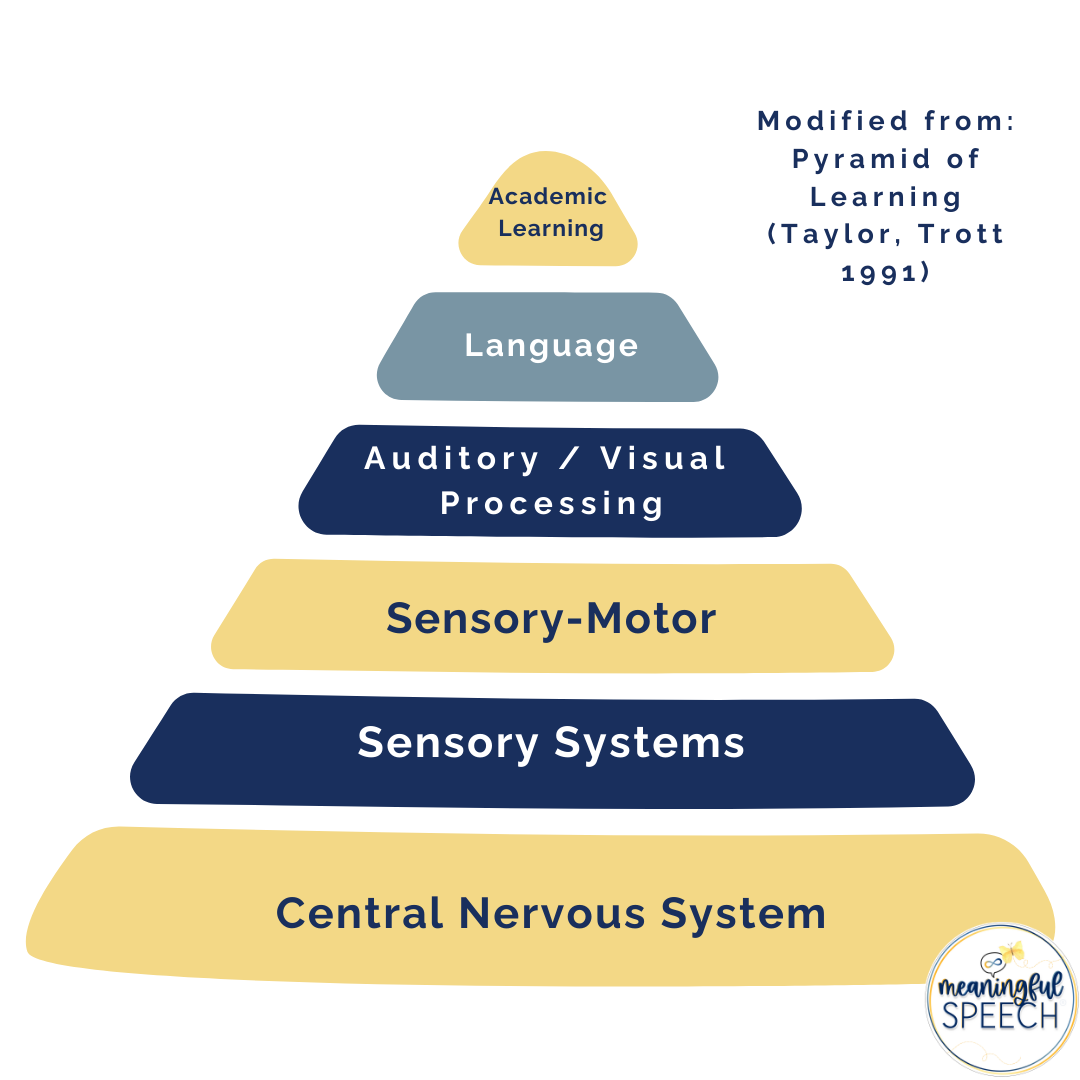
A child needs to feel safe and connected to us to pick up on our language modeling. If there isn’t trust and connection, partnership and attunement then we need to focus on this first. The Trott-Taylor Pyramid of Learning goes into more detail about this. The Pyramid of Learning was developed in 1991 by occupational therapist Kathleen Taylor and special educator Maryann Trott. It’s often referred to as the Taylor-Trott Pyramid of Learning. The visual is extremely helpful in showing how the nervous and sensory systems are foundational for a child’s learning and development.
When we aren’t regulated we can’t learn or access language. We need to consider these foundational systems and how we can support them proactively before we can expect a child to engage in our sessions and before we focus on modeling language.
4. Reduce Direct Questioning
Asking questions is a common way to engage children, but it can be frustrating for gestalt language processors in the early stages of language development. Most cannot reliably answer questions until they begin self-generating language (Stages 3-4+). Instead of asking questions, narrate, comment, or simply pause to give them space to process.
Instead of:
- “What’s that running by?”
Try:
- “Look! It’s a cat!”
This approach provides a mitigable potential gestalt model for the child to potentially pick up and use in the future.
5. Don't take scripts literally
Gestalts often aren’t literal. Instead, they reflect an emotional or memorable experience tied to when the child heard the phrase. To understand the meaning, consider the child’s context, body language, and exposure to media.
Questions to Explore the Script’s Meaning:
- What media do they frequently watch or listen to?
- Is there a specific time or situation when they use this script?
- Does the intonation match a familiar scene or phrase?
When in doubt, ask caregivers who know the child’s language history well.
6. Embrace Child-Led Interactions
The best way to model language for a gestalt language processor is during child-led interactions and natural opportunities.
Example:
Before a session, a parent shares that their child loves movement activities and sensory play. You set up an obstacle course, a sensory swing, and a bin filled with beans. When the child chooses an activity, you follow their lead and model language naturally.
The child jumps into the swing.
- Adult: “Time to swing!”
This natural modeling offers meaningful language without pressure or expectation.
When to Seek Support
A knowledgeable professional can help you better understand your child’s communication style and how to support it. If your child uses echolalia to communicate, you’ll want to find a clinician who is knowledgeable about gestalt language development. To help with this, we’ve created a registry of clinicians who have completed our Original Meaningful Speech Course on Echolalia, Natural Language Acquisition and Child-Led Therapy, our course on AAC & Gestalt Language Processing or both. Find a speech-language pathologist near you here: www.meaningfulspeechregistry.com.
In the meantime…
Start with our free 54-minute Masterclass on Echolalia & Child-Led Therapy. It’s a great starting point for caregivers, family members, professionals… anyone who wants to better understand gestalt language development and how to support gestalt language processors.
In the masterclass, we explain more about what echolalia is, how gestalt language processors develop language, and how child-led approaches can support language in everyday interactions.
We also encourage you to share the masterclass with the people in your child’s life: family members, educators, therapists, and caregivers. When the adults around a child understand how they are developing language, it becomes much easier to support their communication.